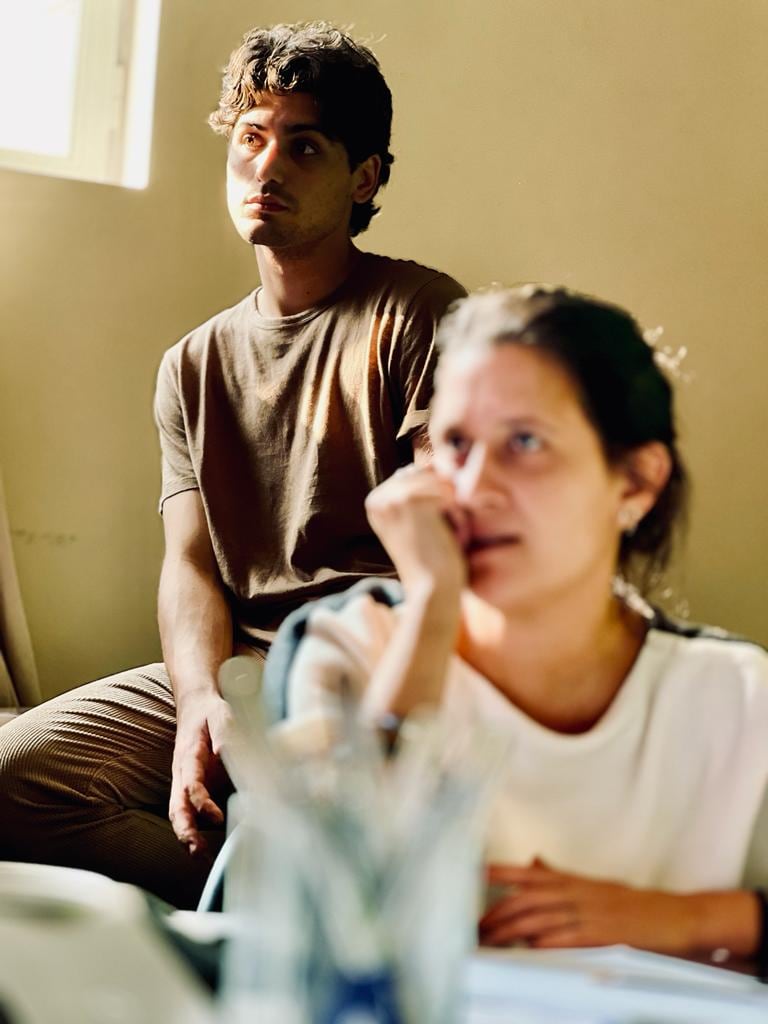
This photograph does not show a presentation, a stage or the delivery of a project. It shows a weekly meeting between project managers. That is precisely why, to me, it says more than many official pictures ever could.
We are in a meeting room. I am in the background; Bianca is in the foreground. Mattia took the photograph, and I have always liked its light, but it is more than a beautiful image. It is a memory of an environment where I learned an important part of my profession: by watching more experienced people, listening to how they approached a problem, and bringing to the table each week what was working and what was not.
An agency is a very fast school
Agency life means moving constantly from one client to another, from one language to another and often from one industry to another. One project may combine technology and digital art; the next may concern a financial process, an event or an editorial platform. That variety leaves little room for memorised formulas. It forces you to understand context quickly, find the right people and turn needs that are still unclear into concrete decisions.
Working with major clients gave me responsibility, but the truly formative part was being surrounded by highly capable professionals. Account managers, creatives, developers, designers, producers, sales leads and technical specialists all looked at the same project from different angles. My job was not to know each craft better than they did. It was to understand every perspective well enough to help them move in the same direction.
"Project management did not teach me to have every answer. It taught me to recognise the missing question."
What I learned from Bianca
Bianca was a senior project manager and one of my mentors. I learned from her mainly through everyday work: how to prepare a meeting before it starts, how to separate a real urgency from noise, how to speak with a client without promising what the team cannot deliver, and how to protect people's work without losing sight of timing and objectives.
That was also the purpose of our weekly PM meetings. They were not a corporate ritual filled with status updates. They were where risks became visible, solutions were shared and everyone learned from other people's projects. A problem handled by a colleague could become a useful tool in my own project the following week. It is a form of continuous training that rarely appears on an organisation chart, yet profoundly shapes professional growth.
A PM works in the middle
A project manager occupies an uncomfortable and valuable position: between client and team, between an idea and what can actually be built, between desired quality and available time. You need to read a proposal, build a plan, follow a budget, facilitate decisions, handle the unexpected and communicate with people who use very different vocabularies. Sometimes within the same hour.
That position gave me a genuinely all-round education because it prevented me from hiding inside a single specialism. It taught me to move from detail to the wider picture and back again; to know when to step in and when to make room; and to translate a commercial request into feasible work without emptying it of its purpose.
Other people's expertise does not diminish yours
One of the most important lessons agency life taught me is that working with people who know more than you do does not undermine your value. It increases it, provided you are willing to observe and ask. Professional confidence does not come from pretending to know everything. It comes from knowing who you need and creating the conditions for that person to do good work.
It is the same thread I recognise in the invisible work behind a project and in learning to work across technology, communication and people.
Many of those meetings have blurred together in my memory. This photograph has not. It reminds me that a decisive part of professional growth happens exactly like this: in a room, with capable people, while trying to do a better job than the week before.