Living alongside elephants requires protecting wildlife, human safety and livelihoods together. Assessing a response means asking more than whether it deters animals: who maintains it, under which conditions it works and which risks remain?
An elephant nearby can be a visitor's most anticipated encounter. Beside a cultivated field, the same proximity raises different questions. Recognising that difference does not require inventing an individual farmer's story.
A specific case near Tsavo East
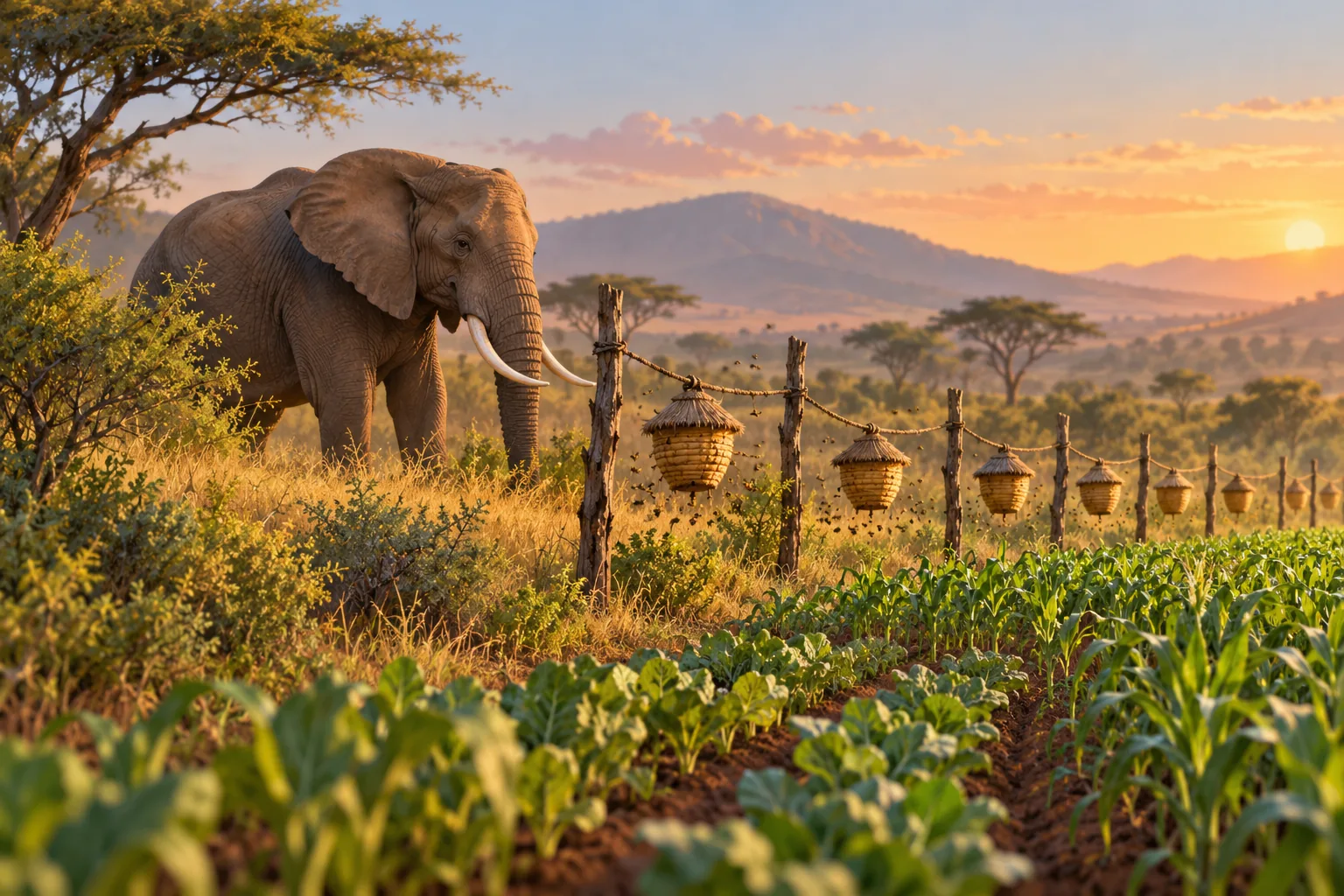
A 2024 Conservation Science and Practice paper examines nine years of beehive-fence use in Kenya. It reports annual mean deterrence of approximately 76% across the study period and results up to 86.3% during peak crop seasons after good rainfall.
Save the Elephants' account, from an organisation involved in the research, describes 26 farms in two villages near Tsavo East and explains drought-related challenges for hive occupation and honey production.
These findings concern a specific setting and period. The percentages are not universal guarantees or direct measures of an equivalent reduction in every kind of damage.
What does “works” mean?
A percentage becomes useful when we understand what it counts. Approaching elephants, field entries, damaged area, lost harvest and people's safety are different dimensions.
An assessment can therefore ask:
- ●which event is recorded;
- ●what comparison is used;
- ●over what period;
- ●at what operating cost;
- ●with which effects on participants.
This does not dismiss the intervention. It clarifies which result the evidence supports and which would require a different measure. A persuasive number should help readers understand the question rather than replace it.
Maintenance belongs inside the solution
Installation is one stage. A proposal should also explain who maintains the system, who has the necessary training and how difficult periods are handled.
The question is about responsibility over time. Describing only the visible object can conceal the work needed to keep it functioning. Any related income-generating activity also needs its own assessment: sales, costs and continuity are not interchangeable.
These are questions for individual projects, not allegations of undocumented shortcomings at the farms studied.
People are not an additional consideration
Protecting elephants and reducing risk for farmers belong in the same discussion. Further reporting should include farmers' own accounts: what improves, which tasks increase and who participates in decisions?
The sources consulted do not constitute an independent survey of every household's views. It would therefore be misleading to state that “the community is satisfied” as though a community had a single voice.
A selected photograph or testimony can introduce a question. It cannot settle the assessment on behalf of everyone affected.
What this changes for a traveller
Understanding that a wildlife landscape is also inhabited can improve questions about visitors, animals and local activities. Not every trip offers access to these processes, and people should not become another attraction to inspect.
Travellers can still ask for a checkable explanation of an offered activity: who runs it, who chose to participate and what a stated contribution includes. This extends the work of making considered travel decisions.
The aim is not to expect a holiday to resolve complex questions. It is to recognise when a simple promotional description leaves important responsibilities unexplained.
The denominator changes the meaning of a percentage
The University of Kent's institutional record makes the paper's abstract accessible even when the publisher's site is unavailable. It distinguishes elephants breaking through a fence from those entering through a gap at its end. That matters: not breaking a fence and not entering a field are not necessarily identical observations.
An assessment therefore needs clear counting boundaries. An annual mean, an aggregate event count and a seasonal result are not interchangeable. The question is which measure describes the outcome being examined, rather than which produces the most attractive headline.
If protecting a harvest is the objective, checking what happens within the cultivated area matters too. If operational continuity is the question, maintenance and hive conditions need attention. Different indicators can describe the same intervention without contradicting each other.
Plan for the day when the system is insufficient
An intervention should not be assessed only when everything works as intended. As a project criterion, ask what reporting route has been agreed for problems and who is responsible for responding. This is not advice on confronting an elephant: those situations require competent local contacts and procedures.
The point is organisational. A device can form part of a response without automatically replacing responsibility, communication and maintenance capacity. Its cost should be assessed in that wider context rather than reduced to installation alone.
An account of the case can keep three strands distinct: ecological information about animal movement, operational information about the intervention, and social evidence about people's experiences. Research may illuminate parts of these without settling every question.
A more concrete question remains than “is this a good idea?”: in which setting, for which objective and under which conditions does it produce a checkable result? That allows innovation to be appreciated without turning it into a miracle solution. It also gives future reporting a clear purpose: revisit the conditions, not merely repeat the original success figure.
Three questions to keep together
Do beehive fences always prevent elephants entering?
No. The study records partial results that vary with conditions and period.
Does deterrence equal the same reduction in financial damage?
Not automatically; these are different indicators.
Can the findings be applied to all Africa?
No. The case helps frame better questions rather than erase differences between places.
Coexistence becomes more concrete when it describes work, responsibility and measurable outcomes.
Wildlife recovery in Gorongosa also requires separating numerical growth from the other outcomes a project seeks.