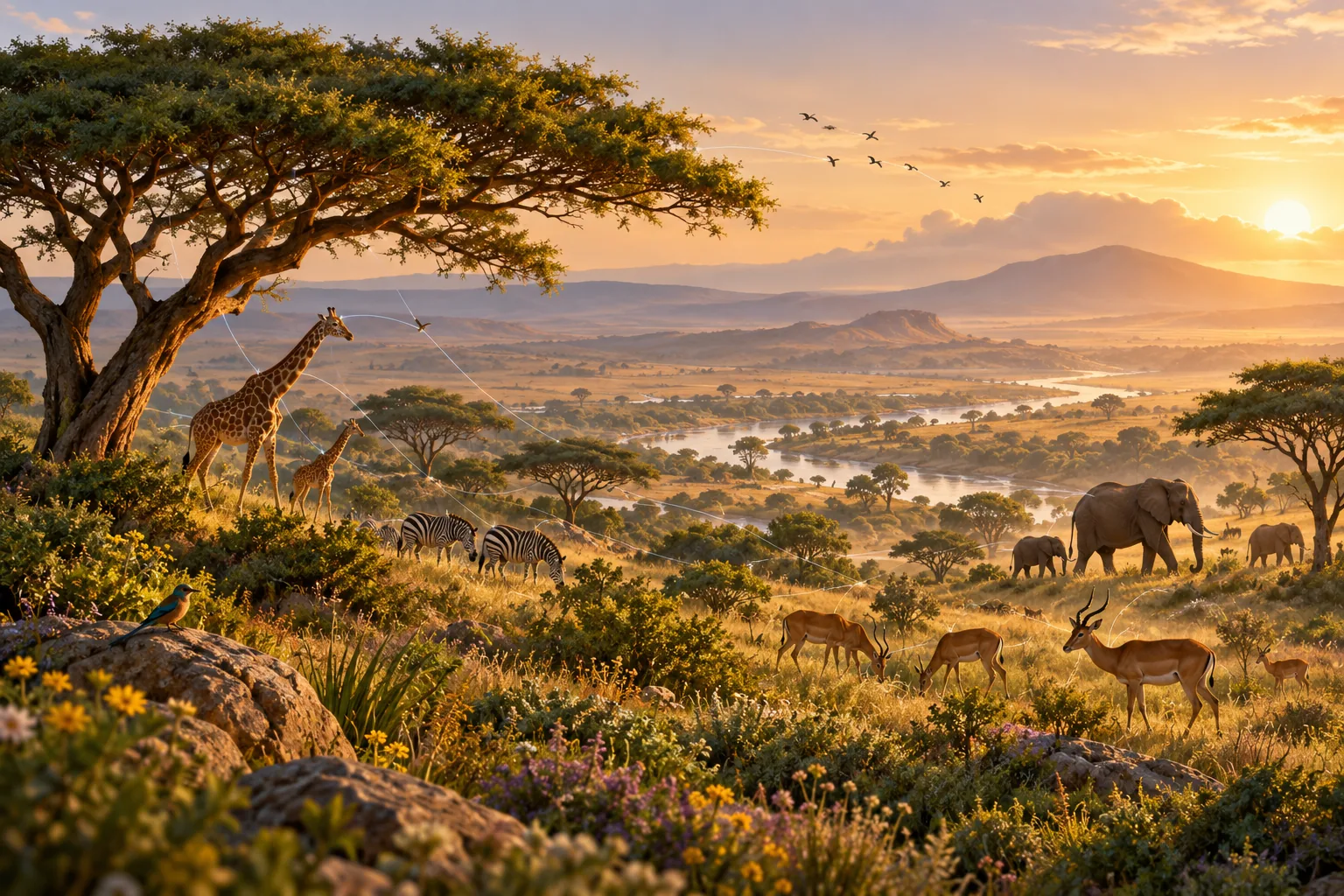
A park's recovery cannot be assessed only by the number of animals returning. It also matters which species recover, how they coexist and which relationships are rebuilt. Gorongosa, in Mozambique, helps explain the distinction: a landscape can become abundant again without returning to its earlier composition.
A photograph full of wildlife conveys abundance immediately. Understanding conservation requires another question: compared with which baseline, measured when and using what method?
What the research documents
A 2019 PLOS ONE study compares aerial counts before and after Mozambique's civil war. It documents severe large-herbivore declines followed by recovering biomass, but with a markedly changed species composition. Natural growth after protection resumed contributed more to numerical recovery than reintroductions.
These findings concern the park and data examined through 2018. They are neither a description of all Mozambique's wildlife nor a current 2026 census.
Abundance and composition answer different questions
Consider a simplified example: two areas contain the same total number of herbivores. One total is spread across many species; the other is concentrated in one. The headline count alone cannot describe the structure of these communities.
Three questions help keep an assessment clear:
- ●Quantity: are we measuring individuals, density or biomass?
- ●Composition: which species are present, and in what proportions?
- ●Relationships: which ecological interactions have actually been observed?
This is a reading framework rather than an additional research finding. When a project announces an increase, ask exactly what increased. Precision can make an achievement more understandable without diminishing it.
A baseline needs a date
Recovery also requires a reference point. Is the comparison with a historical low, a pre-war survey or a management target?
Without that reference, apparently conflicting statements may describe different parts of the same process. A population may have increased substantially from its lowest point while remaining far from another baseline.
A clearer account names the measure, period and location before choosing its adjective. The less dramatic sentence can be the more useful one, especially when a reader wants to compare projects rather than admire a headline.
Tourism is not a complete explanation
The cited research does not establish tourism as the sole cause of recovery. A claim that one activity explains a complex transformation would need specific evidence.
For travellers, a more practical question is what demonstrable role their proposed trip plays. An association with a park, a declared contribution and an independent evaluation are different kinds of information. A memorable photograph remains a visitor's experience, not a measure of programme effectiveness.
That distinction also informs the relationship between travel, observation and storytelling: what is visible during a visit cannot represent everything happening in a place.
People need their own measures
More wildlife does not automatically answer questions about the costs and benefits experienced by people living nearby. Assessing those issues would require separate information about participation, opportunities, damage and dispute resolution.
These are questions for further investigation, not social outcomes established by the wildlife study. A responsible account should make room for what its evidence cannot answer instead of using ecological recovery as a substitute for every other result.
What changes when fear changes
A second study makes ecological relationships more tangible. In 2019 research described by Princeton University, Gorongosa bushbuck also used open floodplains. Predator sound and scent cues prompted movement towards woodland, while researchers examined effects on the plants being eaten.
Behaviour matters because equally numerous populations may use space differently. Following an ecological chain therefore means observing where animals move and what happens to other organisms. Counts and experiments answer complementary questions.
This is not proof that any predator reintroduction will produce the same outcome. The experiment's strength lies in isolating a specific relationship; careful interpretation means resisting a universal recipe.
A reading sheet separating achievement from unfinished work
To compare projects, build four rows: objective, available evidence, limitation and next check. If the objective is a species returning, numbers are relevant. If it is restoring an ecological function, that function needs its own measure.
Imagine a hypothetical project announcing the return of a herbivore. Ask whether the animals survive, reproduce and use the expected habitats. Keep those checks separate from questions about farming and residents. A positive result in the first row does not automatically complete the others.
This changes language too. “Animals introduced”, “population established” and “ecological relationship observed” describe different stages. Naming the stage reached allows progress to be recognised without presenting the story as finished.
Where evidence is missing, the sheet retains a question. That gap tells readers what an account cannot yet establish. It is more useful than asking one adjective, such as sustainable, to describe ecology, finances and social fairness simultaneously. The approach also makes updates easier: new evidence changes a specific row instead of requiring every earlier judgement to be accepted or rejected as a whole.
Reading the next conservation success story
Before sharing a headline, look for a precise place, period, indicator, method and limitations. Then ask what remains unmeasured.
Has Gorongosa returned to its earlier state?
The 2019 study describes asymmetric recovery rather than simple restoration of the earlier composition.
Do its findings apply to all Mozambique?
No. The study area is the park.
Does a successful safari prove conservation success?
A sighting documents an encounter. Evaluating a programme requires additional evidence.
For another perspective on conservation and everyday life, living alongside elephants shifts the question towards people's costs and responsibilities.