Assessing a Namibia itinerary means examining the time available each day: route, road surface, stops and flexibility matter alongside distance. The question is how much time remains to experience a place before another stop is added.
An itinerary often starts with a list: dunes, coast, wildlife, a landscape seen in a photograph. Lines on a map follow. Problems begin when those lines are treated as empty space between interesting destinations.
A better planning question is what a whole day involves, from setting out to settling in.
Distance is only one input
The UK's FCDO advises checking road conditions and avoiding night driving outside towns because of wildlife and livestock. 1 The Tour and Safari Association of Namibia also offers guidance on gravel-road driving. 2
When comparing proposals, ask about the actual route, surface, stops, arrival time and contingency margin. Rather than assigning a universal travel time to a distance, seek an estimate for the particular journey and its assumptions.
These are itinerary-assessment questions, not a driving manual or a guarantee of safe travel.
Design a day rather than filling it
Imagine two hypothetical programmes without assigning real distances or places. One puts arrival, an activity and departure close together. The other offers fewer appointments and more time in one location.
There is no single answer for every traveller. The difference should simply be visible before booking.
For each stop, identify what needs a fixed time, what can move and what could be dropped. If everything is essential, the schedule has little flexibility. This is a planning method rather than a technical safety threshold.
Photography changes priorities
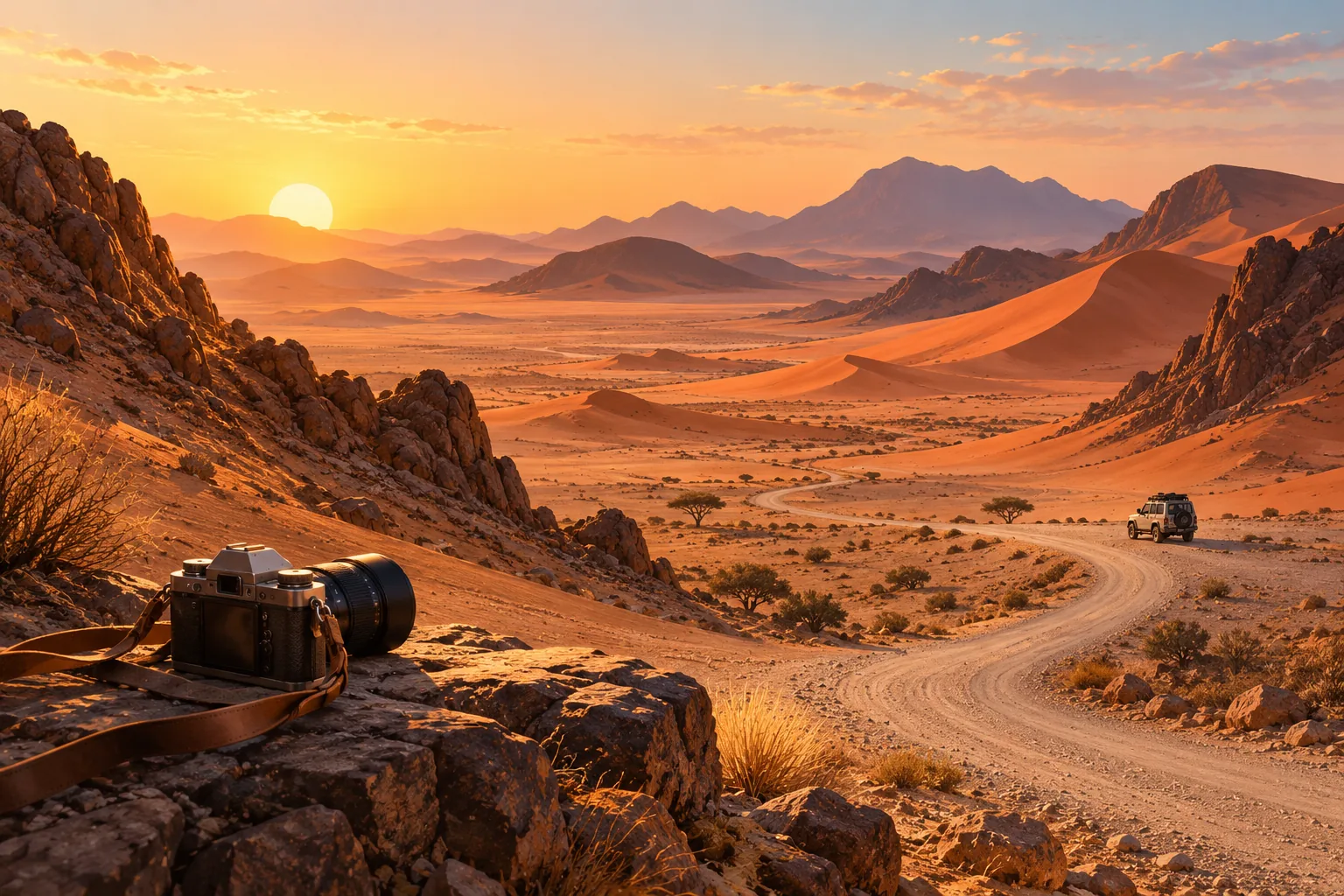
Someone travelling with a camera should mention their preferences before the group settles the number of stops. Do they want frequent pauses, more time observing one environment, or a different pace from their companions?
The aim is not to build every day around a photograph. It is to prevent an important preference emerging only once the group is already on the road.
Wanting less time behind the wheel is also planning information. It does not need to be compensated for by adding more activities. A useful proposal makes these choices discussable.
The route belongs to the landscape
TASA asks visitors to remain on designated roads, highlighting the damage off-road driving can cause to fragile environments. 2 That also matters when looking for a photograph.
Agree stops in ways compatible with the location, traffic and applicable rules. An appealing viewpoint does not justify making a new track.
Vehicle-specific instructions belong with the provider and people familiar with the route. This article does not prescribe tyre pressures, driving techniques or a particular vehicle.
Count the hours that are not transfers
A simple exercise can help compare a day. Write down planned departure and desired arrival, then place estimated travel, stops, meals and activities inside that interval. The aim is not false minute-by-minute precision but visible assumptions.
If activities occupy the entire interval, ask what changes when a stop takes longer. A clear proposal distinguishes flexible elements from those needing confirmation. Unallocated time is a planning choice rather than automatically wasted time.
Consider a hypothetical group: two people value pauses for photography while two prefer reaching accommodation earlier. Neither preference is wrong. Difficulties arise when a programme treats them as identical. Before adding stops, discuss which moments need to be shared and where flexibility exists, subject to the operator's arrangements and rules.
A stop costs more than its overnight rate
An additional destination has a time cost as well as a financial one: reaching it, settling in and departing again. These actions may reduce actual time there even when the itinerary includes a night in the destination.
Read arrival and departure together. One overnight stay may allow an unhurried visit, while another may be a brief pause between transfers. The description is similar but the experience can differ substantially.
Adding the destination may still be the right choice. The point is to understand the demand it places on the day rather than discovering an already crowded schedule on arrival. Comparing itineraries means making trade-offs visible: more places, a slower pace, observation and comfort do not automatically increase together.
The exercise also helps on an accompanied trip. Operational decisions belong with the people who know and manage the route; participants' preferences become more useful when communicated beforehand. A shared proposal comes from comparing both kinds of information.
Recording the agreed priorities can help later too. When a change becomes necessary, the group and operator have a clearer basis for discussing what matters most instead of reopening every decision from the beginning.
Five questions for the planning conversation
- 1.Which days are mainly transfers?
- 2.Which times are estimates, and on what assumptions?
- 3.Where are stops and overnight stays planned?
- 4.What alternatives exist if a route changes?
- 5.Could one stop be removed to make room for what matters most?
The answers help compare proposals beyond their price. A shorter itinerary is not automatically better; a longer one is not automatically more complete.
Before adding another name to the map, look at the day being built. The important choice is how much of the trip to devote to movement and how much to staying.
For the broader approach, read organising a journey means taking care of decisions.
The Okavango's water cycle offers another example of turning a place's characteristics into concrete questions about a proposal.